LATEST NEWS

Dr Emilia visits UR-CAVM-attends Science Day at the Campus

In a bid to witness the operation, the level of research and available facilities in the University of Rwanda, Dr Emilia Molnar from Swedish Embassy paid a visit to the College of Agriculture, Animal Sciences and Veterinary Medicine-Busogo Campus located in the northern part of the country. The visit was also in line with Emilia’s mandate to oversee funded activities of the Government of Sweden through UR-Sweden Programme for Research, Higher Education and Institutional Advancement.

During the visit, Dr Laetitia Nyinawamwiza gave an overview about the College and noted that her College has a high stake in community engagement as it regularly reaches out to farmers to give them guidance on proper ways to handle their cattle and fields for better production. She also highlighted the need to give an impetus to creativity and entrepreneurship to ensure that research outputs are translated into innovation. 

“We need qualified and experienced  staff to work in research and innovation offices to be able to ensure that technology transfer can happen,” she said adding that the College is coming up with mechanisms to spur students’ mentorship programme with a view to maximize employment opportunities.

Dr Nyinawamwiza (right) giving an overview of the College to the visitors

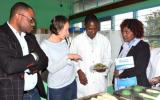
Dr Emilia who is the Senior Programme Manager for Research and Higher Education at Swedish Embassy along with the Coordinators of UR-Sweden Programme witnessed the available facilities during the campus tour. Among the impressive laboratories visited were the Food Science laboratory which was very active and students showcased their ongoing and completed experiments. Tissue culture lab was equally remarkable and demonstrated outstanding skills in plant by technology practical and seeds multiplication.

In the course of the tour, lab technicians were urged to have a career grow in their own field like other academic staff. According to Nyinawamwiza, lab technicians should aim for PhD since they play a significant role in assisting PhD students, doing experiments and co-publish with other researchers without necessarily moving to academics positions.  

visit to campus laboratories

The visit was sealed by research presentations dubbed “Science day” organized by the College with the support of UR-Sweden Programme. Five academics presented their research outputs including two ongoing PhD students in Sweden.

Presentations were kicked off by Prof Francois Naramabuye who is specialized in Soil Sciences.  In his presentation on “Natural Resources and Land use Planning Tradeoffs Tool” Naramabuye proposed ways for proper management and well domestication of water resources available in the country. The next presenter was Olive Tuyishime who took the audience through her research on the “Impact of soil salinity on rice yield”.

Olive’s experiment is being conducted in the Eastern Province of Rwanda in Nyagatare District. She is a PhD student at Swedish University of Agricultural Sciences (SLU) in Sweden. Among other presented topics was from Prof Charles Bucagu, an Associate Professor in Agroforestry & Dean of School of Agriculture and Food Sciences who presented on “Exploring tools for determining and managing maize yield gaps in Rwanda”. In his presentation, he expressed the urge for farmers to be enabled so that they can predict yield and timely find out factors likely to reduce yield and make informed interventions.

Research presentation; bottom right clockwise; Mr Ndahetuye, Prof Bucagu, Prof Naramabuye and Ms Tuyishime

Other presentations were made by Prof Srinivasan Thoppe, Professor in Entomology who presented on “Bioprospecting symbionts in soil pests, wood feeding insects and plants for potential bioactive molecules” as well as “Mastitis in dairy cows in Rwanda: characterization, prevalence, aetiology, and effects on milk quality” presented by Jean Baptiste Ndahetuye, also a student at Swedish University of Agricultural Sciences (SLU) in Sweden.

In her remarks, Dr Emilia hailed the organization witnessed in the Campus as well as efficient utilization of limited available facilities. She also called on academics and researchers in general to keep up the culture of sharing their research by consistently organizing science days.  

Part of College’s ongoing initiatives include encouraging PhD staff and researchers in general to conduct their research activities by harnessing available facilities in the college which will ultimately improve the research culture and boost laboratories in the campus. 

More event photos

By  Darius Murangwa
Communications Officer
Maiden Pi Day celebrated at UR to give impetus to Mathematics

14 March, 2018; the University of Rwanda joined the world to observe the International Day of Mathematics known as Pi Day (π-day) with a view to demystify sciences and recognize the importance and applications of mathematics in society. The event was organized in collaboration with UR-Sweden Programme, the African Institute of Mathematical Sciences (AIMS) and East African Institute for Fundamental Research.  

In his opening remarks, Prof Philip Cotton, UR-Vice Chancellor encouraged young science students in attendance to join the University of Rwanda where they will be groomed to be scientists at the best. He also informed female students that the University of Rwanda has female staff members with PhDs in mathematics who should inspire young girls to do mathematics.

Opening remarks by Prof Cotton, UR Vice Chancellor

Speaking on the occasion, Dr Bengt-Ove Turesson the UR-Sweden Programme Coordinator and representative of Swedish Embassy at the event said Sweden will maintain support to University of Rwanda’s education and infrastructures development programmes. He also called on UR to consistently organize the annual event in a bid to inspire and attract aspirant scientists. 

Dr Bengt-Ove during his address to particiants in Pi day

“We hope Pi Day annual celebration will get bigger and repeated because Mathematics is a pillar to other STEM areas” said Dr Bengt-Ove

According to Dr Ignace Gatare Principal of College of Science and Technology, University of Rwanda, the celebration is an important day to all mathematician and society in general and a moment to acknowledge the importance of mathematics in all science subjects.

“Mathematics is core in all aspects of people’s daily lives” he said

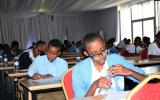
The event in Kigali featured a mathematics competition for secondary students from 10 science schools, including eight based in Kigali and two from the countryside.

students during the competition

The challenge winner was Yvan Gatete from Lycée de Kigali followed by Arnaud Sebukono, from College Saint André in Nyamirambo, and Eric Ishimwe from Lycée de Kigali.  

Yvan Gatete receiving a certificate from the Vice Chancellor

The winner was awarded $500 and an Ipad while the second, third and fourth winners were granted school fees sponsorship at their respective schools for this year courtesy of UR-Sweden programme.

The award for best female student went to Aline Utetiwabo from Gashora Girls Academy.

Dr Gatare handing certificate to Utetiwabo; best female student

Participating schools were Gashora Girls Academy, Maranyundo Girls Schools, Lycée De Kigali, APE Rugunga in Kigali, Fawe Girls School, Lycée Notre Dame de Cîteaux, College Saint André in Nyamirambo, Green Hills Academy, Nu Vision High School in Kabuga, and White Dove Girls School.    

A section of students participants at the event

By  Darius Murangwa
Communications Officer

Swedish delegation visit UR to discuss joint research collaboration

The University of Rwanda hosted a two day meeting with an academic delegation from three Swedish varsities to discuss joint research collaboration. The event is organized in line with the recently ten established research clusters that are expected to boost interdisciplinary research approach for economic growth and social transformation.  

The discussions were presided over by Dr Charles Murigande who noted that the move is meant to uphold the culture of interdisciplinary research approach which is instrumental to deal with the complexity of developmental challenges. Fields like Energy, transport, agriculture and ICT are among ten key areas that will mark the upcoming research collaboration.

Discussions were moderated by Dr Murigande

“We are trying to catch up in the field of energy which is prerequisite to the development; knowing that the Government of Rwanda has an ambition to provide access to electricity to each home by 2024” said Murigande who is UR Deputy Vice Chancellor for Institutional Advancement.  In other areas, he added that management and economics will also be given an impetus since they are reckoned to be the backbone of all the businesses in which the country endeavours to boost.

He also stated that the development of the country is closely linked to the deeds of the University of Rwanda as the sole public University with the mandate to transform the country from agrarian society into a knowledge led one.

It was also observed that UR has started the journey to be a research led institution and is poised to be active in knowledge generation by collaborating with the region and international community. The development of local PhD programmes has been also undertaken which will enable UR to develop a critical mass of researchers.

Prof Herman Musahara was part of the group that developed the concept note that featured research clusters. He noted that the University of Rwanda rates high the training of PhD as one of the answers for problems of the country. According to him, the concept note was nested into the existing national and regional policies  as well as global imperatives such as SDGs and crosscutting areas; gender and environment to mention but a few.

Remarks by Prof Musahara

“Research clusters are also meant to boost social economic transformation and economic development while establishing substantial bond with the industry,” said Musahara, adding that clusters are designed in such a way that they are mutually intertwined to uphold synergy amongst them.

The collaboration between UR and Swedish varsities has been possible thanks to the existing support by UR-Sweden Programme that strives to promote research culture and capacity at the University of Rwanda. The support has enabled the University to have qualified staff and this was vindicated by the fact that UR won a competitive bid worth 20 million/USD from the World bank to fund four Centres of Excellence.

Among other key research players in attendance was Mr Raymond Ndikumana who is the Overall Coordinator of UR-Sweden Programme. In his remarks, he called on the research clusters to find scientific basis with regard to national and regional priorities and other global commitment such us SDGs. He urged the cluster champions be pragmatic amid the development of letters of intents which is a competitive process to be reviewed by external team appointed by the Government of Sweden.

Mr Raymond sharing his thoughts during the meeting

 Research clusters

  1. Agricultural transformation and food security:
  2. Social Economic transformation and sustainable development
  3. Environment, Natural Resources Management and Climate Change
  4. Inclusive Governance, Peace and Security
  5. Urbanization, Green Cities, and Human Settlements
  6. Transformative ICT and Knowledge Management
  7. Health and Wellbeing for All
  8. Sustainable Energy and Manufacturing
  9. Transformative Education, Culture and Creative Arts
  10. Transport and Logistics

Prof. Cotton, UR Vice Chancellor was also present

Prof Kaplin presented on Research clusters

Swedish researchers and UR counterparts

Full access to all the event photos : Click here

By  Darius Murangwa
Communications Officer