LATEST NEWS

Sweden commits to extend its support to UR for another year

The University of Rwanda has benefited one more year of collaboration with the Government of Sweden in the existing support through Swedish International Development Cooperation Agency (Sida). The extension agreement was signed by Prof. Philip Cotton, UR Vice Chancellor and Dr Emilia Molnar from the Embassy of Sweden in Rwanda.

The existing support to the University of Rwanda through Sida under the coordination of UR-Sweden Programme is mainly focusing on the areas of research and higher education. This contributes to Rwanda’s high ambition of building individual and institutional capacities.
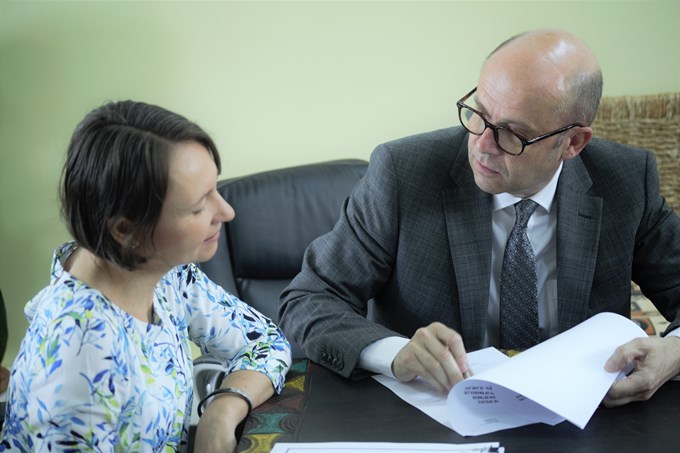
Phil Cotton & Emilia.jpg

Dr Molnar (L) and Prof Cotton during the signing of new agreement

According to Prof. Phil Cotton, Swedish support enables the University of Rwanda to achieve its mandate, which is in part to engage in research that helps to solve the problems of the country.

 “The collaboration leads to research that has an impact on policy making and provision of evidence for policies that might come through from the government,” Cotton said. 

Speaking on the occasion, Dr Emilia Molnar commended UR for the commitment demonstrated during previous phases of the partnership. Emilia who is the Senior Programme Manager for Research and High Education in the Swedish Embassy also called on all players into the partnership to ensure that the extension concentrates on activities that are result oriented.

From the agriculture as the most type of work in Rwanda, the collaboration has enabled generation of knowledge through the training of Masters and PhD. This is leading to the increase of the critical mass of specialists who are catalysts for the transformation and modernization of Rwandan agriculture sector.
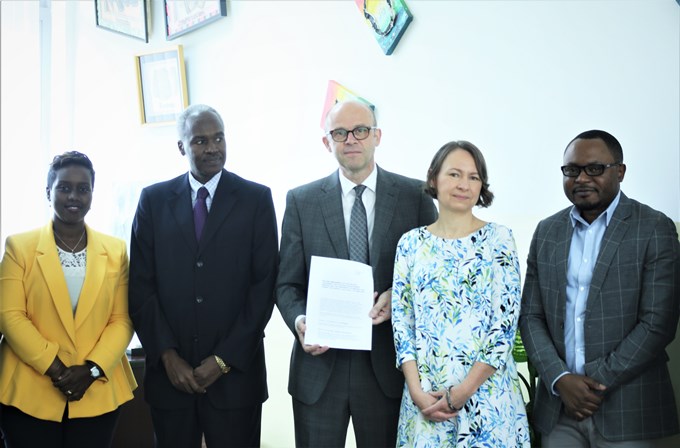
UR SWEDEN.jpg

From right: Mr Raymond Ndikumana (Overall Coordinator of UR-Sweden programme), Dr Molnar, Prof. Cotton, Amb. Dr Charles Murigande and Dr Sylvie (Deputy Coordinator and Student Manager)

Equally, with Swedish support a number of publications are being made to inform right choices in economic and finance sectors in a bid to ensure a stable macroeconomic environment and sensible exchange rate policy.  The move is poised to complement Rwanda’s quest to move from a purely agriculture based economy to more industry and service economy.

The same applies to the Information and Communication Technology (ICT) being essential engine driving Rwanda’s transformation to a knowledge-based economy. The Programme has heavily invested in ICT research especially ICT in education, ICT in Government and Public sector, telecommunication and computer engineering and computer science.

 Good progress is being made in the field of medicine, law and other critical areas like environment and Peace and conflicts. 
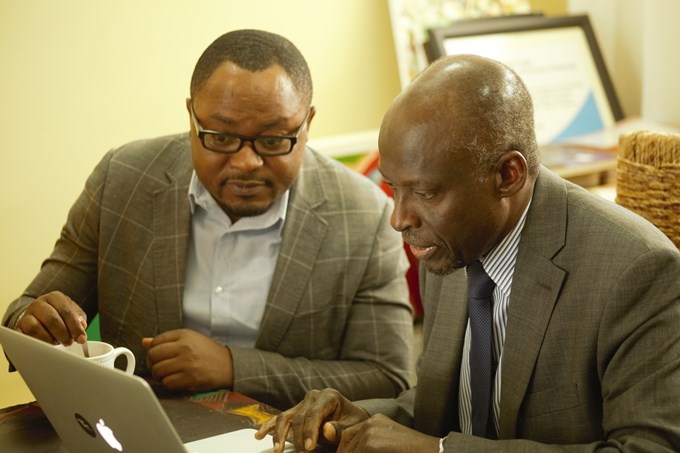
Nelson & Raymond.jpg

On the sideline of the signing: Prof Ijumba and Mr Raymond during the discussion

By  Darius Murangwa
Communications Officer
4 UR dons earn PhD degrees from Sweden under the Swedish partnership

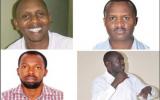
Four (4) University of Rwanda academics have successfully defended their PhD thesis in the course of one week from various Swedish varsities. The academic staff have been pursuing their doctoral studies in line with the existing collaboration with Swedish Government through Sida under the coordination of UR-Sweden Programme for Research Higher Education and Institutional Advancement.  The defense took place in the week of 11th to 15th June, 2018 and all the new doctors return to UR as lecturers and are also poised to carry on research in their respective fields to make an impact in the community.

Bottom right clockwise: Dr Nsabimana, Dr Habimana, Dr Akashi and Dr Mutwarasibo

The defense was kicked off by Dr Aimable Nsabimana from the department of Economics, Swedish University of Agricultural Sciences, Uppsala-Sweden.  His thesis is entitled “Essays on Household Demand and Agricultural Policy Implication in Developing Countries”.  His thesis compiles papers covering the area of food demand and agricultural policy related issues. Papers I-II examines the welfare implication from adopting modern agricultural inputs and the effects of the likely changes in rainfall on food market prices in Rwanda context. Paper III investigates the reliability of unit value or community price when computing demand elasticities in Tanzania. Finally, Paper IV explores food Engel curves and consumption patterns in Rwanda.

Dr Nsabimana (C) & HE Nkulikiyinka (R)Ambassador of the Republic of Rwanda to the Nordic countries

Next was Dr. Olivier Habimana who defended his thesis on “Asymmetry and Multiscale Dynamics in Macroeconomics Time Serie Analysis” from Jönköping University, Sweden. His areas of interest include but not limited to Time series econometrics, Dynamic panel data models, Financial economics, International economics. Habimana has three master's degrees in economics from The University of Turin (Italy, 2011), The Paris Institute of Political Studies (Sciences Po, France, 2011) and Sapienza University of Rome (Italy, 2013).

Dr Habimana (circled) with UR DVC Administration & Finance Musafiri (2nd R) & Prof. Kigabo (2nd L) from National Bank of Rwanda

Another PhD holder is Akashi Andrew Rurangirwa who also successfully defended his PhD thesis “Quality and Utilization of Antenatal Care (ANC) Services in Rwanda” from the University of Gothenburg, Sweden.  In his research, Akashi investigated pregnant women’s attendance and timing of ANC visits and the occurrence of intimate partner violence (IPV) with associated factors. Besides, he examined the prevalence of non-psychotic mental health disorders (MHDs) during pregnancy and after childbirth and to what extent violence exposure would contribute to poor mental health. Healthcare providers’ (HCPs) practices in prevention, detection and management of maternal conditions were investigated quantitatively including patients’ records (quality control sub-study).

Dr Akashi after his PhD thesis defense

The weekly PhD thesis defenses were closed by Dr Ernest Mutwarasibo from the School of Global Studies at the University of Gothenburg, Sweden. His PhD thesis is “Ordinary Choices in Extra-Ordinary Times: Exploring Resistance to Genocide in Rwanda in 1994”. He explored how and why, in their perspectives, some persons made resistance during the Genocide against the Tutsi in Rwanda, in 1994. Mutwarasibo says that his study brings into dialogue the respective literatures on Genocide and resistance studies, particularly in that they both focus on the oppressive power exercise.

By  Darius Murangwa
Communications Officer

UR and Swedish partners meet to plan ahead of the new financial year

A 4-day Annual Review Meeting was convened in Kigali between the University of Rwanda and Swedish partners to discuss activity plan for the financial year 2018-2019.  The high level meeting is organized in line with Sweden support to Rwanda through Sida under the coordination of UR-Sweden Programme for Research, Higher Education and Institutional Advancement. The meeting will assess and discuss priorities, key performance indicators and revised planning for the next financial year to ensure the success of the partnership between the two countries.

 Speaking during the opening, Amb. Dr Charles Murigande commended the holistic support by the Government of Sweden to the University and to Rwanda at large. He noted that Sweden was the 1st country to believe that Rwanda needed a strong and well-functioning higher education. Among the areas of support at the University of Rwanda he mentioned the improvement of research environment and institutional advancement to ensure efficient management.


Amb. Dr Murigande during the meeting

 “Supporting education is the best way to support the development of Rwanda,” said Murigande who is UR Deputy vice Chancellor for Institutional Advancement.

 In his remarks, Mikael Boström the Head of Development Cooperation at Sweden Embassy noted that the meeting means a critical reflection of the past on what has not been achieved as planned. According to him, it looks on revisiting the main underpinning reasons and set the new targets to ensure good living condition to all people especially those living in poverty.


Mikael Boström; Head of Development Cooperation at Sweden Embassy

 Boström added that the training research partnership looks on to strengthen institutional research capacity at the University of Rwanda so that Rwanda can have its own strong system of knowledge production able to address challenges related to poverty reduction and sustainable development.  

 In his presentation, Mr Raymond Ndikumana the Overall Coordinator of UR-Sweden Programme said that the Programme has contributed to UR’s ambition of becoming a research-led university.  On top of a dedicated line and mechanisms for doing research, he noted that the Programme has supported area of innovation and sustainable ICT, research expertise in many different ways through trainings for PhD supervisors and improvement for skills in research management to mention but a few.


Mr Ndikumana during his address to the APM participants

 At least 29 PhD students have graduated thanks to the Programme support. 33,000 e-journals already subscribed to ease access to online content while 9 in-house masters’ programmes are being run.

 Among the key participants in the meeting was Dr Emilia Molnar, the Senior Programme Manager for Research and Higher Education at Swedish Embassy. During her presentation on Human rights based Approach within Research Cooperation, she asked researchers to ensure that the community benefits from their research results. According to her, there is a fine line between human rights and Research in the sense that for example “it is the rights of farmer to benefit from research results”. 


Intervention by Dr Emilia during the meeting

 Emilia also called for upholding academic freedom which enables academics to debate freely while doing researches that are guided by pure research curiosity without any political influence.

 The meeting  discussed proposals & letters of intents that will mark the extension of collaboration up to 2024. The new partnership is expected to result into critical mass of training in areas of poverty reduction and sustainable development while mainstreaming gender, environment and other crosscutting areas.


Sections of APM participants


The group photo by APM participants

By  Darius Murangwa
Communications Officer